


Housing Starts Ease in Early 2026
Presents Opportunities For Londoners
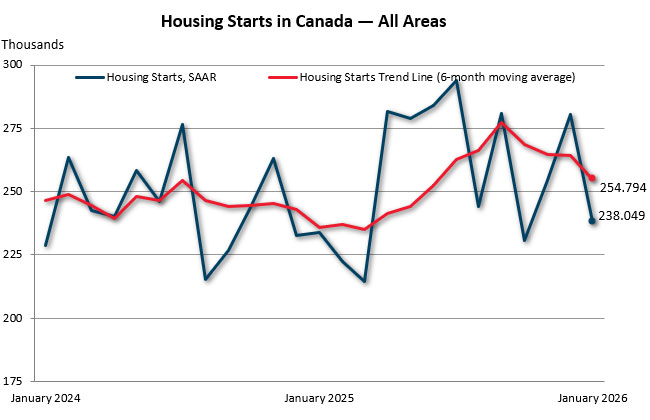
The January 2026 CMHC housing starts report shows that new residential construction slowed at the start of the year. Nationally, the seasonally adjusted annual rate declined 15% from December, and the six-month trend has now fallen for four consecutive months.
At the national level, this tells us builders are being cautious. Rising construction costs, softer demand, inventory levels, and broader economic uncertainty are clearly influencing development decisions.
But real estate is local.
And here in the London, Ontario real estate market, this shift doesn’t automatically signal weakness. In many ways, it opens the door to opportunity.
Housing Starts Ease in Early 2026
A More Balanced Market Can Create Smart Buying Windows
When housing starts trend lower, it often reflects developers pausing to assess demand. That pause can benefit buyers.
In recent years, new-construction homes in London, Ontario, sold quickly, often with little room to negotiate. In today’s environment, we’re beginning to see something healthier: balance.
Builders may be more flexible on:
- Upgrade packages
- Deposit structures
- Closing timelines
- Spec home pricing
That doesn’t mean prices are collapsing. It means the urgency has cooled. When urgency cools, decision-making improves.
For buyers considering new builds in Hyde Park, Talbot Village, Summerside, Byron, or surrounding communities such as Komoka and Kilworth, this market adjustment can create leverage that simply wasn’t available during peak competition.
CMHC’s Report
The CMHC January 2026 housing starts data also highlights an important dynamic: while monthly figures can swing sharply, the six-month trend offers a clearer picture. That broader measure is drifting lower, suggesting the pipeline of new homes could tighten over the next 12 to 24 months.
That matters. Because when fewer homes break ground today, fewer homes are completed tomorrow.
Canada continues to face long-term housing supply challenges. Despite softer short-term momentum, structural demand remains. London remains supported by Western University, Fanshawe College, healthcare expansion, advanced manufacturing, and steady regional population growth.
Slower housing starts now could translate into firmer conditions later.
Another factor worth watching locally is the continued interest in flexible housing options.
Properties with secondary suites, separate entrances, or multi-generational layouts remain attractive. London’s evolving Additional Residential Unit (ARU) policies have encouraged homeowners and investors to think creatively about income support and long-term adaptability.
In a market where construction costs remain elevated, existing homes with built-in income potential can be highly appealing.
We’re still seeing steady demand from:
- Parents purchasing near Western
- First-time buyers seeking mortgage offsets
- Multi-generational families
- Long-term rental investors
Even when national housing supply trends shift, these fundamentals tend to remain stable in mid-sized cities like ours.
For sellers, the slowdown in housing starts is not inherently negative. If fewer new homes enter the market next year, well-priced resale properties could face less competition from builder inventory.
Presentation, preparation, and realistic pricing remain key — but the market is far from stalled. It’s adjusting.
And adjustment is healthy.
Key Takeaway
The key takeaway from the CMHC housing starts report is this: the market is recalibrating, not collapsing.
Developers are being measured.
Buyers are being selective.
Inventory levels are being absorbed at a more sustainable pace.
That’s not a crisis. That’s a transition.
For those watching closely, transitions are often where opportunities lie.
If you’re considering buying a new-construction home in London, Ontario, investing in a rental property, or preparing to list your home this year, understanding housing supply trends can help you time your decisions strategically rather than emotionally.
Every market cycle offers a distinct set of advantages. The key is knowing how to position yourself within it.
If you’d like to discuss what these national housing starts numbers mean for your neighbourhood, price range, or long-term plans, I’m always happy to connect.

Elevate Real Estate Group
Read More From Elevate Here:
Can London, Ontario, Afford to Turn Down 286 New Rental Units at Ridout & Kent?
London Job Losses: What Rising Unemployment Means for the 2026 Real Estate Market