

Is It Time for Arva to Join London?
A Sewer Capacity Crisis Raises a Bigger Question About Growth
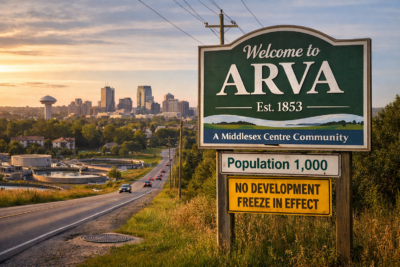
A recent decision by Middlesex Centre to implement a one-year building freeze in Arva highlights a problem that often remains behind the scenes of community growth: infrastructure capacity. So, Elevate Real Estate Group with Royal LePage Triland in London is asking the question… Is it time for Arva to join London?
Arva’s sanitary sewer system is directly connected to the City of London’s system through a servicing agreement that allows for a certain average daily flow. When this limit is surpassed, it becomes harder to justify new development approvals. As a result, we are experiencing a slowdown in growth as officials examine the system and seek solutions.
At first glance, this appears to be a technical issue related to pipes and treatment capacity. In reality, it prompts a bigger question for the region.
If Arva increasingly functions as a suburb of London, should it eventually become part of the city itself?
Arva Is Already Part of London’s Economic Orbit
Arva is only minutes north of London along Richmond Street. Residents shop in London, work in London, and depend on London’s hospitals, schools, and employment centres.
For many people, the distinction between Arva and London exists mainly on a municipal map. It is another Byron, Wortley Village, etc Yet when it comes to infrastructure and planning, that boundary matters.
Arva is part of Middlesex Centre, while the sewer system it relies on is owned by the City of London. When growth pressures increase, the two municipalities need to negotiate capacity, upgrades, and infrastructure investments. That arrangement works well in stable times. It becomes more complicated when growth accelerates, especially during a housing shortage.

Is It Time for Arva to Join London?
Could London’s Growth Boundary Expand That Far North?
One possible solution that occasionally appears in discussions like this is municipal annexation, the process by which one municipality absorbs land from another.
In Ontario, municipalities are created by the province. The Municipal Act, 2001, governs their structure and allows boundary changes through restructuring or annexation proposals. Annexation simply means jurisdiction over a land area shifting from one municipality to another.
If Arva were annexed by London, the city could take full responsibility for: sewer and water infrastructure, development planning, zoning, and road & transportation systems
In principle, this could enable growth to be integrated into the broader urban system rather than relying solely on inter-municipal agreements.
But how would something like that actually happen?
How Annexation Could Legally Happen
In Ontario, there are several possible paths for municipal boundary changes.
-
Agreement Between Both Municipalities
The most common route is cooperation.
Under the Municipal Act, neighbouring municipalities can collaboratively submit a restructuring proposal to the Ontario Minister of Municipal Affairs and Housing. If approved, the province can issue an order to adjust the boundary.
In practice, this would involve:
- Negotiations between London and Middlesex Centre
- Council approval from both municipalities
- A restructuring proposal was sent to the province
- Provincial approval and implementation
This process often involves public consultations and financial negotiations related to assets, infrastructure, and tax revenues.
-
A Provincial Act or Ministerial Order
In some cases, the province takes a more direct role.
The Ontario legislature can pass a specific boundary adjustment act that transfers land from one municipality to another. For example, the St. Thomas – Central Elgin Boundary Adjustment Act (2023) transferred a portion of land from the Municipality of Central Elgin to the City of St. Thomas to support development and infrastructure planning.
Similarly, Ontario has introduced legislation adjusting boundaries around growing cities such as Barrie.
In these cases, the province determines that regional growth needs to justify intervention.
-
Public Referendum or Plebiscite
Residents can also be asked for their opinion through a municipal referendum.
Ontario legislation allows municipalities to place binding or advisory questions before voters during municipal elections.
However, referendums are not always decisive.
A famous example is the 1998 amalgamation of Toronto, where multiple municipalities were merged into the current City of Toronto despite strong opposition in local referendums.
Ultimately, the province holds final authority over municipal boundaries.
There Is Plenty of Precedent in Ontario
Boundary changes and annexations are not rare in Ontario.
Examples include: St. Thomas annexing land from Central Elgin to support growth, Woodstock expanding into neighbouring township lands, or even Barrie expanding its boundary to accommodate population growth
Municipal borders have never been fixed in stone. They tend to evolve as cities expand and regional economies change.
Potential Benefits of Arva Joining London
If Arva were eventually incorporated into London, several benefits could arise.
More Land for Housing
London’s growth boundary limits where new neighbourhoods can be built.
Expanding the city boundary could open up new areas for housing, including single-family homes, townhouses, and rental buildings.
At a time when housing supply remains a major challenge across Ontario, additional serviced land could help ease pressure.
Integrated Infrastructure Planning
A unified municipality could plan sewer and water expansion as part of a single system.
Instead of negotiating capacity limits between municipalities, London could directly invest in:
new trunk sewer lines, expanded treatment capacity, and coordinated stormwater systems
Transportation and Transit Planning
Arva already sits along a major transportation corridor into London.
Annexation could allow:
- better road planning
- potential transit expansion
- integrated long-term growth strategies
The Concerns Residents Would Raise
Any discussion of annexation inevitably raises concerns as well.
Preserving Community Character
Arva’s appeal has long been its village atmosphere.
Many residents may worry that integrating into London could speed up urbanization and lead to higher-density development.
Taxes and Municipal Services
Property taxes, service levels, and planning policies would change under London’s governance.
Some residents might benefit from expanded services, while others could see higher costs.
Urban Sprawl Debates
Some planners argue that cities should focus on intensifying development within existing boundaries rather than expanding outward. The ongoing debate in Canadian planning revolves around the balance between urban density and greenfield development.
A Conversation That May Eventually Happen
For now, the sewer capacity issue in Arva may be temporary. Middlesex Centre is studying options to reduce flow and identify potential upgrades.
But situations like this often spark larger discussions about how cities develop. When infrastructure, housing needs, and municipal boundaries overlap, the question of restructuring naturally comes up. Whether Arva stays part of Middlesex Centre or eventually joins London, one thing is clear:
Regional growth is forcing communities to rethink how municipal boundaries and infrastructure planning work together.
And sometimes, the pipes beneath the ground reveal challenges that go far beyond engineering.

Elevate Real Estate Group
Read More From Elevate Here:
First Time Buyer Rebate 2026: Up to $50,000 for First-Time Buyers of New Homes


