


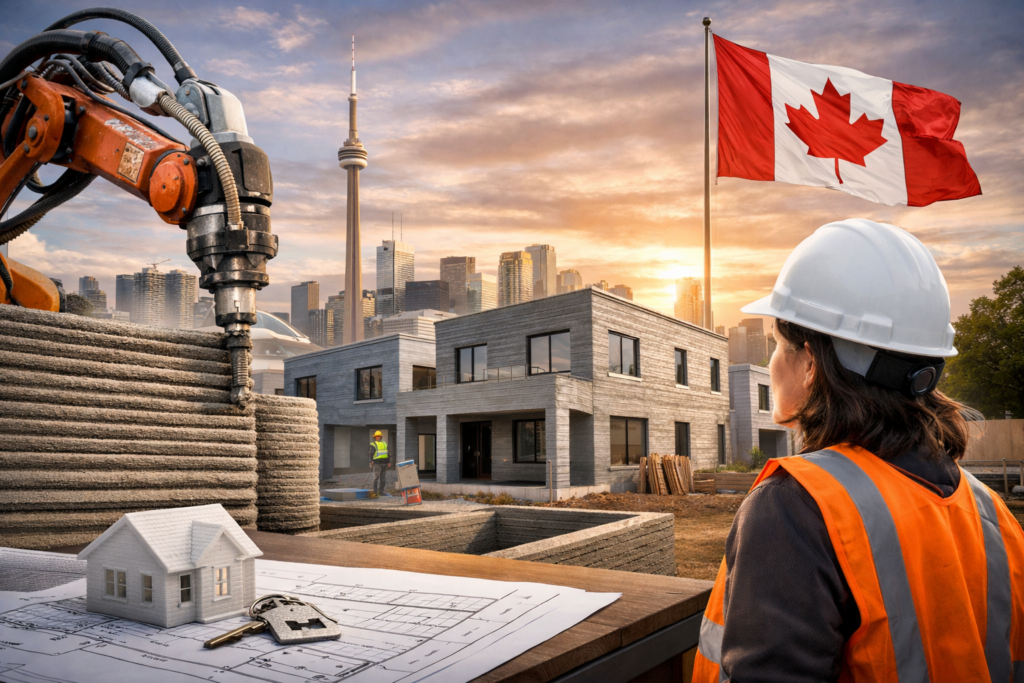
Should We Bet Big on 3D-Printed Homes
What It Means for Housing in Ontario
Canada’s housing crisis has sparked no shortage of bold ideas, but few are as eye-catching — or as controversial — as 3D-printed homes. While the technology promises faster builds and lower costs, its real-world adoption has been slower than many hoped.
A recent CBC News feature by Angela Hennessy explores why some Canadians are making major investments in 3D-printed housing and why the construction industry has been cautious about following. The story offers an important lens on how innovation collides with regulation, labour realities, and market readiness — especially here in Ontario.
A Big Bet on a New Way to Build
The CBC story profiles Linda Reisman, an Ontario resident who invested nearly $700,000 of her savings into a robotic arm capable of 3D-printing concrete walls. After receiving high quotes from traditional builders in Muskoka, Reisman decided to support a technology she believes can help address Canada’s housing shortage.
The appeal is clear: robotic printers can build structural walls in a single day with only a small crew on site. In theory, this dramatically reduces labour demands and compresses timelines — two of the biggest challenges in residential construction today.
However, as the article makes clear, printing walls is only part of the equation. Homes still require skilled tradespeople for plumbing, electrical, roofing, windows, and interior finishes. Convinced traditional builders and lenders to work alongside new technology has proven difficult.
Proof of Concept Exists — But It’s Still Early
Reisman’s experience isn’t happening in a vacuum. CBC points to a 3D-printed townhome project in Gananoque, Ontario, developed by Horizon Legacy and supported by Canada Mortgage and Housing Corporation (CMHC).
According to CMHC, this project is the largest 3D-printed housing development in Canada to date, with robotic arms printing the first-floor walls of multiple units. Some of the finished homes are expected to rent for around $1,000 per month, underscoring real potential for affordability.
Horizon Legacy’s CEO, Nhung Nguyen, told CBC that consolidating framing, drywall, and masonry into a single automated process has shortened timelines and significantly reduced material costs. Within one year of adopting the technology, the company reports material cost reductions of up to 50% and productivity that has doubled.
From a housing supply perspective, that kind of efficiency is hard to ignore.
Why the Industry Hasn’t Moved Faster
Despite these promising examples, experts interviewed by CBC caution against assuming rapid adoption.
Michael Piper, Associate Professor at the University of Toronto’s School of Cities, describes construction as a deeply interconnected system. Even if wall construction speeds up, everything else, including zoning approvals, building codes, inspections, financing models, and insurance underwriting, remains designed around conventional methods.
Toronto Metropolitan University professor Shelagh McCartney also raises important questions about long-term performance, renovation flexibility, and climate suitability, especially in Canada’s northern and colder regions.
In other words, innovation alone doesn’t solve the housing crisis. It must fit within the regulatory, financial, and environmental realities of each region.
Government Support Signals a Shift — But Not a Silver Bullet
The CBC report notes that the federal government allocated $600 million in 2024 to innovative housing technologies, including 3D printing. CMHC has already contributed more than $10 million to pilot projects across the country.
More recently, Prime Minister Mark Carney’s “Build Canada Homes” initiative has emphasized speed and scale, echoing earlier federal messaging on automation and alternative construction methods.
That support matters, but history shows that meaningful change in housing delivery tends to occur incrementally, not overnight.
What This Means for Buyers, Sellers, and Communities
From an Elevate Real Estate Group perspective, 3D-printed housing is best viewed as one tool among many in a much larger toolbox.
It has real potential in:
- Purpose-built rental housing
- Affordable and supportive housing
- Indigenous-led developments
- Remote or labour-constrained regions
But it is unlikely to replace traditional construction in the broader resale and custom-home markets anytime soon.
For homeowners, buyers, and investors in London and southwestern Ontario, the key takeaway is this:
- housing innovation is coming, but it will coexist with, not replace, established building methods for years to come.
The Bottom Line
As CBC’s reporting highlights, 3D-printed homes are no longer theoretical. They exist, they work, and they are improving quickly. At the same time, the housing crisis is complex, and no single solution will fix it on its own.
At Elevate Real Estate Group, we believe the path forward will require a mix of innovation, policy reform, skilled labour, and smart planning tailored to each community’s needs.
We’ll continue to watch how emerging construction technologies evolve and what they mean for housing supply, affordability, and long-term value across Ontario.


Elevate Real Estate Group
Read More From Elevate Here:
London Job Losses: What Rising Unemployment Means for the 2026 Real Estate Market


https://elevatelondon.ca/is-this-the-year-you-buy-a-cottage/
Source
Hennessy, Angela. Why some Canadians are betting big on 3D-printed housing in Canada. CBC News, February 10, 2026.
https://www.cbc.ca/news


